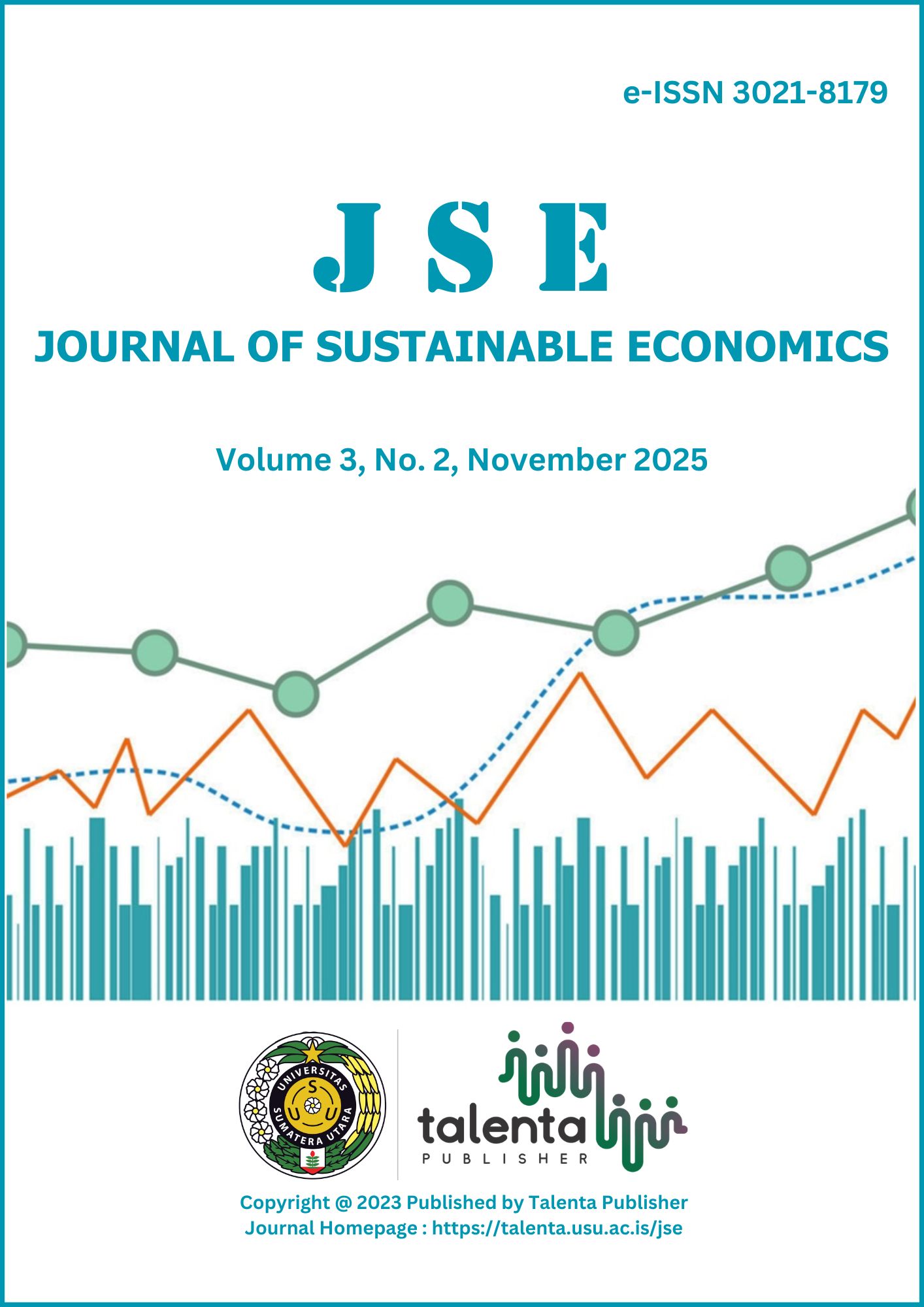
The Role of Internet Usage in Enhancing Economic Freedom through International Trade in Developing Southeast Asian Countries
DOI:
https://doi.org/10.32734/jse.v3i(2).23402Keywords:
Economic Freedom, Internet Usage, Trade Openness, Corruption Perceptions Index, ASEAN, Developing CountriesAbstract
This study examines the impact of internet usage on economic freedom, with a particular focus on the mediating role of trade openness in developing Southeast Asian countries. Utilizing a quantitative explanatory approach with Partial Least Squares–Structural Equation Modeling (PLS-SEM), the analysis is based on balanced panel data from ten ASEAN member states—Indonesia, Malaysia, Thailand, the Philippines, Vietnam, Singapore, Myanmar, Laos, Cambodia, and Timor-Leste—covering the period from 2011 to 2022. The findings reveal a significant and positive direct effect of internet usage on economic freedom. However, the indirect effect through trade openness is statistically insignificant, suggesting that digitalization promotes economic freedom primarily through direct mechanisms rather than by increasing trade integration. Moreover, institutional quality, as measured by the Corruption Perceptions Index (CPI), shows a stronger influence on trade openness than internet access alone. These results underscore the importance of aligning digital transformation efforts with institutional reforms and good governance to fully capitalize on the benefits of the digital economy. This study offers empirical contributions to the literature on digitalization, trade liberalization, and economic freedom, and provides actionable policy insights for developing countries undergoing digital transitions.
Downloads
Downloads
Published
How to Cite
Issue
Section
License
Copyright (c) 2025 Monika Andrasari, Hafnida Hasan, Lucky Satria Pratama , Dewi Ratna Sari Simatupang

This work is licensed under a Creative Commons Attribution-ShareAlike 4.0 International License.