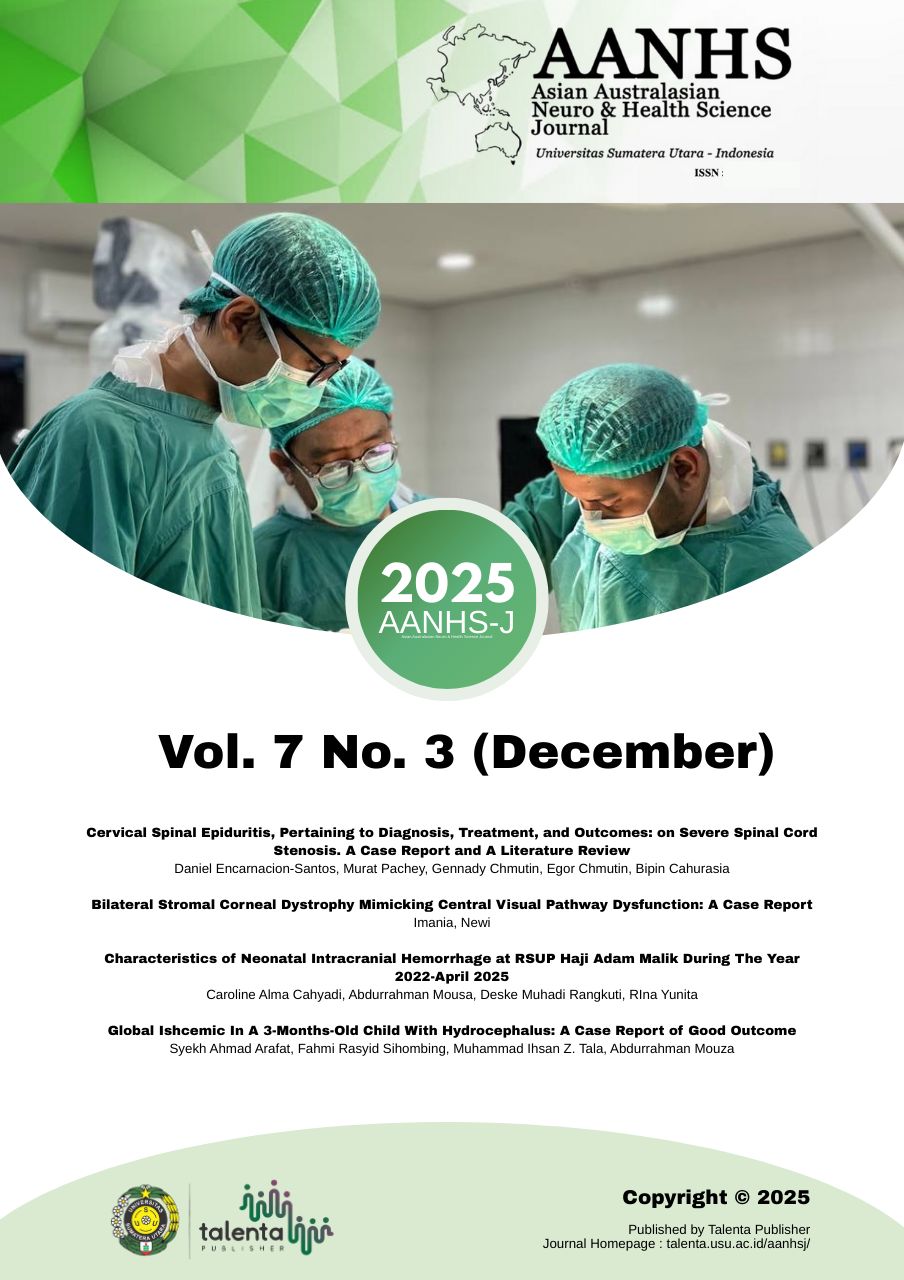
Characteristics of Neonatal Intracranial Hemorrhage at RSUP Haji Adam Malik during the Year 2022-April 2025
DOI:
https://doi.org/10.32734/aanhs-j.v7i03.24097Keywords:
Neonate, Intracerebral hemorrhage (ICH), Intraventricular hemorrhageAbstract
The neonatal state is a vulnerable period where rapid physiological transitions happen. In Indonesia, in the year 2020, the Infant Mortality Rate was 19.83 per 1,000 live births, including a Neonatal Mortality Rate of 9.30. This state is also a part of the critical period of a postnatal brain development. Disruption to the brain during this time window can cause problems in the neurodevelopmental process. One of the examples being intracranial hemorrhage in neonates, which the true prevalence and incidence rates of are unclear, but which have high mortality and morbidity rates. The objective this study is to determine the characteristics of neonatal intracranial hemorrhage at Haji Adam Malik General Hospital in 2022-April 2025. This study used a descriptive design through a retrospective cross-sectional study and a sample of neonates with intracranial hemorrhage at Haji Adam Malik General Hospital through saturated sampling. It was found that incidence rate was 6.24 per 100, with the most common bleeding location being intraventricular 25 (89.3%), the majority of neonates were premature, namely 19 (67.9%), low birth weight 19 (67.9%), the most common symptoms were seizures and respiratory distress 15 (53.6%), and 11 (39.3%) neonates made a good recovery.
Downloads
Downloads
Published
How to Cite
Issue
Section
License

This work is licensed under a Creative Commons Attribution-ShareAlike 4.0 International License.
The Authors submitting a manuscript do understand that if the manuscript was accepted for publication, the copyright of the article shall be assigned to AANHS Journal.
The copyright encompasses exclusive rights to reproduce and deliver the article in all forms and media. The reproduction of any part of this journal, its storage in databases and its transmission by any form or media will be allowed only with a written permission from Asian Australasian Neuro and Health Science Journal (AANHSJ).
The Copyright Transfer Form can be downloaded here.
The Copyright form should be signed originally and sent to the Editorial Office in the form of original mail or scanned document.