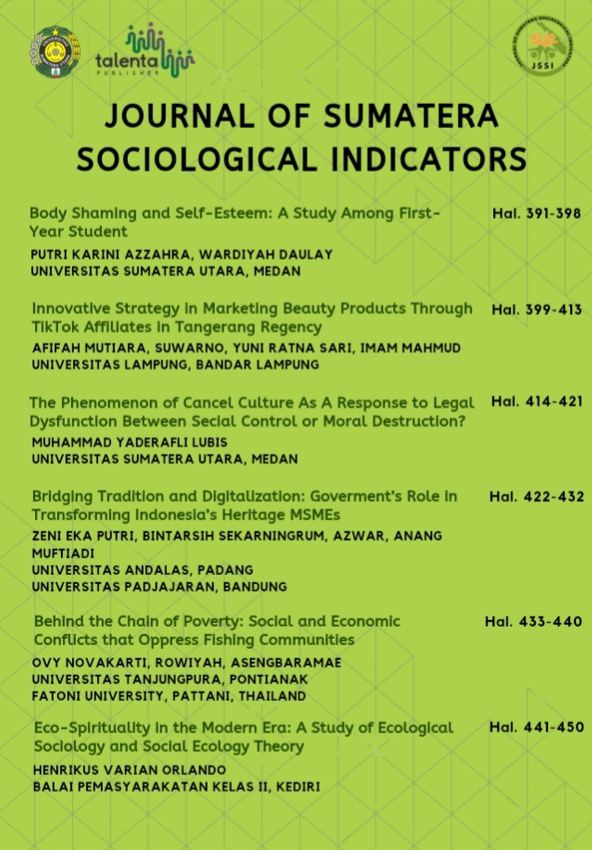
Bridging Tradition and Digitalization: Government’s Role In Transforming Indonesia’s Heritage MSMEs
DOI:
https://doi.org/10.32734/jssi.v4i2.23017Keywords:
MSMEs, Government, Digitalization, Kampung Rendang, Kampung TenunAbstract
This study aims to examine the role of government policies in facilitating the digital transformation of traditional SMEs in Kampung Rendang and Kampung Tenun, Indonesia. It explores how digitalization impacts business sustainability, MSMEs' challenges, and the opportunities enabled through government interventions. Employing a comparative case study approach, this research analyzes SMEs' adoption of e-commerce platforms, digital marketing, and financial technologies. Data were collected through in-depth interviews, field observations, and policy analysis, focusing on government-led digitalization programs and SME adaptation strategies. The study finds that government initiatives—such as branding programs, digital training, and financial assistance—play a critical role in enabling SMEs to adopt digital tools. However, challenges persist, including low digital literacy, inadequate infrastructure, and regulatory inconsistencies. Despite these obstacles, digital platforms like Tokopedia, Shopee, and social media have facilitated access to broader markets and new business opportunities. This research offers a novel perspective by integrating digital transformation frameworks with social capital theory to understand how government policies shape the digital resilience of heritage-based S,MEs. It contributes fresh insights into the intersection of digitalization, cultural heritage, and SME empowerment in rural settings.
Downloads
Downloads
Published
Issue
Section
License
Copyright (c) 2025 Journal of Sumatera Sociological Indicators

This work is licensed under a Creative Commons Attribution-ShareAlike 4.0 International License.