Developing the Use of Google Translate to Enhance Student’s Ability to Translate Acehnese Proverb
Keywords:
Acehnese Proverb, Cultural Studies, English, Quality, TranslationAbstract
One of the uniqueness of Aceh region that describes the image of local culture from the original heritage of the ancestors is the Acehnese proverb. However, it is unfortunate that Acehnese proverbs are now fading to extinction. Acehnese proverbs as an oral cultural heritage must be preserved in this digital era, this study wants to find out the quality of the translation of Acehnese proverbs via Google Translate and also wants to find out the understanding of the Acehnese people towards Acehnese proverbs via Google Translate. This study uses a descriptive-qualitative approach. The test method is used to determine the quality of the translation and questionnaires are distributed to 100 respondents who master Acehnese and English to find out the understanding of Acehnese proverbs with the help of Google Translate. The data source is six Acehnese proverbs with two lines. Analysis of translation quality based on the aspects of accuracy, acceptability, and readability. The results obtained that the translation of Acehnese proverbs into English as an international language via Google Translate is not good. The understanding of the Acehnese via Google Translate is not satisfaction because the translation feels strange because it is inaccurate, unusual, and not easy to read
Downloads
References
Abubakar, Aswita, D., Israwati, Ferdianto, J., Jailani, Anwar, Ridhwan, M., Saputra, D. H., & Hayati. (2022). The Implementation of Local Values in Aceh Education Curriculum. Jurnal Ilmiah Peuradeun, 10(1), 165-182.
Alawi, A. M. (2019). Kualitas Terjemahan Proverb Ke Dalam Bahasa Indonesia Menggunakan Google Translate. Al-Tsaqafa: Jurnal Peradaban Islam, 16(1), 103-116.
Alzain, E., Nagi, K. A., & Algobaei, F. (2024). The Quality of Google Translate and ChatGPT English to Arabic Translation: The Case of Scientific Text Translation. Forum for Linguistic Studies, 6(3), 837-849.
Bania, A. S., & Faridy, N. (2023). Quality of Translation Via Google Translate in Comedy Texts. Englisia: Journal of Language, Education, and Humanities, 11(1), 19-36.
Cancino, M., & Panes, J. (2021). The impact of Google Translate on L2 writing quality measures: Evidence from Chilean EFL high school learners. System, 98(102464), 1-11.
Choiriyati, W. (2019). Indexical Expression in Islamic Communication Dialectics of Aceh (Communication Ethnometology Analysis of Meaning on Islamic Sharia in Aceh). International Journal of Multicultural and Multireligious Understanding, 6(4), 92-102.
Chon, Y.V., Shin, D., & Kim, G.E. (2020). Comparing L2 Learners' Writing Against Parallel Machine-Translated Texts: Raters' Assessment, Linguistic Complexity and Errors. System, 102408.
Farrugia, B. (2019). WASP (Write a Scientific Paper): Sampling in qualitative research. Early Human Development, 133, 69-71.
Feka, V. P., Lawa, S. T. M. N., & Liunokas, O. (2024). Kesalahan Google Translate Dalam Menerjemahkan English Phrasal Verbs ke Dalam Bahasa Indonesia. HINEF : JURNAL RUMPUN ILMU PENDIDIKAN, 3(1), 172-183.
Hakiki, , A. S., Sulthoni, S., Devi, N., & Aziz, A. (2023). Analisis Hasil Terjemah Google Translate dan Chatgpt Bahasa Arab-Indonesia: Study Komparatif. Lanedunc: Journal of Arabic, English, and Indonesian Language Teaching, Linguistics, and Literature, 1(1), 35-53.
Handayani, B. R., Ariyana, Z. M. D., Rahayu, T. I., Amaro, M., & Ulfa, L. R. (2021, 21-23 September). Quality Profiles of the Traditional Shrimp Paste of Lombok. Paper presented in IOP Conference Series: Earth and Environmental Science, Universitas Mataram, Indonesia.
Hansen, K., & Swiderska, A. (2024). Integrating Open and Closed Ended Questions on Attitudes Towards Outgroups with Diferent Methods of Text Analysis. Behavior Research Methods, 56, 4802–4822.
Hakim, L. (2013). Konstruksi Teologis Dalam Hadih Maja. Jurnal Substantia, 15(1), 13-25.
Hall, S., & Liebenberg, L. (2024). Qualitative Description as an Introductory Method to Qualitative Research for Master’s-Level Students and Research Trainees. International Journal of Qualitative Methods, 23,
Hunter, D., Oates, R., Anderson, N., Kok, D., Sapkaroski, D., & Wright, C. (2023). Validation Testing of A Language Translation Device for Suitability in Assisting Australian Radiation Therapists to Communicate with Mandarin-Speaking Patients. Technical Innovations & Patient Support in Radiation Oncology, 26(100207), 1-12.
Hayati, U., Ediyani, M., Maimun, M., Anwar, K., Fauzi, M. B., & Suryati, S. (2020). Test technique as a tool for evaluation of learning outcomes. Budapest International Research and Critics Institute (BIRCI-Journal): Humanities and Social Sciences, 3(2), 1198–1205.
Ibrahim, I. H., & Usman, J. (2021). Cultural values in Acehnese farming-related proverbs. Indonesian Journal of Applied Linguistics, 11(2), 364-371
Iksan, F., Rasyid, H., Faisal, & Junaidi. (2020). Kandungan Nilai Narit Maja Dalam Masyarakat Kabupaten Aceh Barat Daya. Serambi Akademica: Jurnal Pendidikan, Sains, dan Humaniora, 8(8), 1729-1740.
Junlapeeya, P., Lorga, T., Santiprasitkul, S., & Tonkuriman, A. (2023). A Descriptive Qualitative Study of Older Persons and Family Experiences with Extreme Weather Conditions in Northern Thailand. International Journal of Environmental Research and Public Health, 20(12), 6167.
King, K. M. (2019). Can Google Translate Be Taught to Translate Literature? A Case for Humanists to Collaborate in the Future of Machine Translation. Translation Review, 00, 1-17. https://doi.org/10.1080/07374836.2019.1673268
Koby, G. S., Fields, P., Hague, D., Lommel, A., & Melby, A. (2014). Defining Translation Quality. Revista.tradumatica: tecnologies de la traduccio, 12, 413-420.
Leppink, J. (2017). Revisiting The Quantitativeequalitative-Mixed Methods Labels: Research Questions, Developments, and the Need for Replication. Journal of Taibah University Medical Sciences, 12(2), 97-101.
Midena, D., & Yeo, R. (2022). Towards A History of the Questionnaire. Intellectual History Review, 32(3), 503-529.
Miles, M.B. & Huberman, A.M. (2005). Qualitative Data Analysis (terjemahan). Jakarta, Indonesia: UI Press
Muchsin, M. A. (2015). Art and Entertainment in Islam. Jurnal Ilmiah Peuradeun, 3(1), 133-146.
Munkova, D., Hajek, P., Munk, M., & Skalka, J. (2020). Evaluation of Machine Translation Quality through the Metrics of Error Rate and Accuracy. Procedia Computer Science, 171. 1327-1336.
Mursyidin, M., Nuthihar, R., Wahdaniah, W., & RN, H. (2020). Understanding Acehnese proverbs and their relation to the community work ethics. IJELR: International Journal of Education, Language, and Religion, 2(1), 11-16.
Nababan, M., Nuraeni, A., & Sumardiono. (2012). Pengembangan Model Penilaian Kualitas Terjemahan. Kajian Linguistik dan Sastra, 24(1), 39-57.
Noels, K. A. (2014). Language Variation and Ethnic Identity: A social Psychological Perspective. Language & Communication, 35, 88-96.
Napitupulu, S. (2017). Analyzing Indonesian-English Abstracts Translation in View of Translation Errors by Google Translate. International Journal of English Language and Linguistics Research, 5(2), 15-23.
Nasir, C. (2015). Attitudes of Acehnese People towards Acehnese Proverbs in Relation to Education. Studies In English Language And Education, 2(1), 45-60.
Onuegbu, O. C., Anorue, I. L., & Oghwie, B. O. (2024). Journalists Knowledge And Utilisation Of Google Translate Application In South East, Nigeria. Caleb International Journal of Development Studies, 7(1), 159-169.
Rowe, N. C., Schwamm, R., & Garfinkel, S. L. (2013). Language translation for file paths. Digital Investigation, 10.
Saputra, N., Suwandi, S., & Setiawan, B. (2023). The Reception of Acehnese on Hadih Maja in the Formation of Children’s Character Values in Aceh. Journal of Namibian Studies, 33(S2), 400-414.
Sari, B. K., Saragih, A., & Zainuddin. (2018). Translation Strategies in Translating the Acehnese Proverbs into Bahasa Indonesia. Jurnal Linguistik Terapan Pascasarjana Unimed, 15 (2): 90-101.
Saricoban, A. (2012). Translation to test vocabulary and language skills. Procedia-Social and Behavioral Sciences, 46, 2959-2963.
Shah, T. Z., Imran, M., & Ismail, S. M. (2024). A diachronic study determining syntactic and semantic features of Urdu-English neural machine translation. Heliyon, 10(e22883), 1-16.
Syafitri, N. L., & Ardi, H. (2023). Translation Quality of Expressive Language in Poetry from English into Indonesian Made by English Department Students. Journal of English Language Teaching, 12(3), 968-975.
Syarfuni. (2014). An Analysis of English and Indonesian Idioms and Proverbs. Getsempena English Education Journal, 1(1), 26-50.
van Rensburg, A., Snyman, C., & Lotz, S. (2012) Applying Google Translate in a higher education environment: Translation products assessed. Southern African Linguistics and Applied Language Studies, 30(4), 511-524, DOI:
Wang, S., Ramdani, J. M., Sun, S. (A)., Bose, P., & Gao, X.(A). (2024). Naming Research Participants in Qualitative Language Learning Research: Numbers, Pseudonyms, or Real Names?. Journal of Language, Identity & Education, 1-14.
Wu, Y., Silver, R. E., & Hu, G. (2024). (2024) Minority language testing: the social impact of the Zhuang language proficiency test in China. Journal of Multilingual and Multicultural Development, 45(8), 3326-3343,
Yang, Z., & Yu, C. (2024). Is The Use of Multiple choice Items and A Holistically scored Paragraph Translation Task Fair? Examining A Large scale Translation Subtest. Asia Pasific Education Review.
Downloads
Published
How to Cite
Issue
Section
License
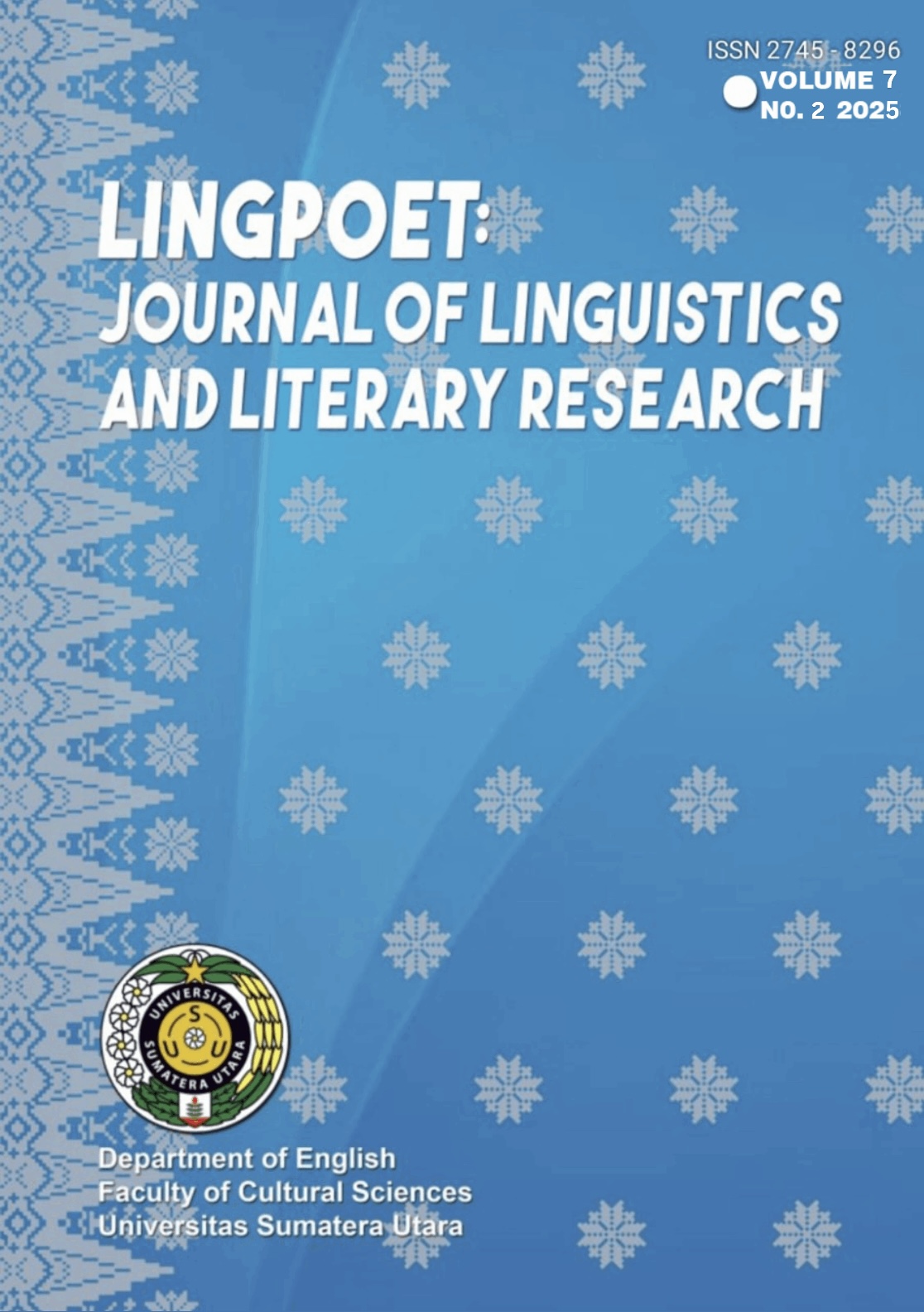
Copyright (c) 2026 LingPoet: Journal of Linguistics and Literary Research

This work is licensed under a Creative Commons Attribution-ShareAlike 4.0 International License.